Friday, 29 June 2018

Marcel Huijser (Montana State University): Road Ecology: Are we taking the right turns?


Data: 03 de julho de 2018
Date: July 03rd, 2018

Hora: 13h:00
Time: 1h:00 PM

Local (Room): Sala de defesa de tese, Bloco O, Prédio da Pós graduação, Instituto de Biologia, Unicamp, Campinas, São Paulo, Brasil

Ecologia de estradas: estamos no caminho certo?

A ecologia de estradas teve avanços substanciais nas ultimas décadas. Nosso conhecimento aumentou e medida mitigatórias visando a redução do impacto das estradas e do trafico sobre a vida selvagem estão agora difundidas e são implementadas regularmente. Em muitos casos, as medidas mitigatórias visam a segurança humana ao reduzir a colisão de veículos com mamíferos de grande porte, ao fornecem oportunidades de travessia segura para os animais, podendo até mesmo fazer sentido implementar estas medidas de um ponto de vista econômico. Esses sucesso talvez sejam razões para celebrarmos. Entretanto, talvez seja a hora de pensarmos se estamos seguindo o caminho certo. Quais são os efeitos das estradas e do trafico que estamos mitigando? Estamos esquecendo alguma coisa? O que nós precisamos fazer para que as medidas mitigatórias sejam implementadas em sessões de estrada de interesse para a conservação das especies mas que não são preocupantes do ponto de vista da segurança humana? As regiões que estão sendo mitigadas são as corretas e estão de acordo com nosso objetivos? Quais são os nossos vieses? Podemos melhorar os projetos dessas medidas mitigatórias para torna-las mais efetivas? Podemos ser mais inteligentes e melhorar a efetividade dessas medidas? Podemos quantificar o que é necessário para alcançar nossos objetivo?


Road Ecology: Are we taking the right turns?

Road ecology has made substantial advances over the last few decades. Our knowledge has increased and mitigation measures to reduce the impacts of roads and traffic on wildlife are now widespread and implemented regularly. In many cases, the mitigation measures address human safety through reducing collisions with large mammals, provide safe crossing opportunities for wildlife, and it can even make economic sense to implement these mitigation measures. These successes may be reason to celebrate. However, it may also be time for
us to think about whether we are taking the right turns. What are the effects of roads and traffic that we are mitigating? Are we forgetting things? What do we
need to do to get mitigation implemented along road sections that are a concern to biological conservation but that are not a major safety concern? Are the locations we mitigate the correct locations and are they consistent with our objectives? What are the biases in our processes? Can we improve on the design of the mitigation measures to make them more effective? Can we be smarter and optimize the effectiveness of mitigation measures? Can we quantify what is needed to achieve our objectives?


Marcel Huijser is a lead researcher in road ecology at the Western Transportation Institute at Montana State University, USA, where he leads a range of road and wildlife related projects for state and federal governments, counties, foundations, and other funders. He was the lead scientist on the 15-year long US Highway 93 wildlife mitigation project, which was a 90km long highway duplication project that dissected important natural habitats, agricultural land, and small villages on the Flathead Indian Reservation. 
Marcel is recognised internationally for his work on the development and testing of animal detection systems that alert drivers to the presence of large mammals along highways, having conducted trials in Yellowstone National Park, California, Colorado, Idaho, Montana, and Pennsylvania. Marcel and colleagues at WTI have undertaken a number of commissioned reports for the national US government on measures aimed at reducing wildlife-vehicle collisions and at mitigating the barrier effects of transportation infrastructure. 
Marcel is also a visiting professor at the University of São Paulo in Brazil where he has been teaching road ecology on a regular basis since 2014 and collaborating on a diverse suite of road-impact and mitigation studies. Some of these Brazilian projects include quantifying roadkill along the toll roads in São Paulo State, the development of a Brazilian animal detection system, and the evaluation of wildlife mitigation measures along the road through Carlos Botelho State Park that hosts one of the largest remaining fragments of Atlantic forest in Southern Brazil with threatened and endangered species such as the jaguar, southern muriqui and South American tapir. Marcel’s Ph.D. (2000) was on hedgehog road mortality and mitigation strategies in The Netherlands, in collaboration with the Dutch Society for the Study and Conservation of Mammals. In his spare time and professionally, Marcel writes a blog of road ecology photos. His photo website probably hosts the largest collection of road ecology images in the world.
Thursday, 28 June 2018

Goggy Davidowitz (University of Arizona): What do pollinators do with the nectar they drink?


Data: 05 de julho de 2018
Date: July 05th, 2018

Hora: 13h:00
Time: 1h:00 PM

Local (Room): Sala de defesa de tese, Bloco O, Prédio da Pós graduação, Instituto de Biologia, Unicamp, Campinas, São Paulo, Brasil

O que os polinizadores fazem com o néctar que eles consomem?

Polinizadores geralmente são atraídos paras as flores pelas recompensas do néctar. Néctar é muito mais do que só açúcar e água, ele também pode conter aminoácidos, ácidos graxos e microrganismos. Nós rastreamos o destino desses componentes do néctar por meio de isótopos estáveis de carbono. Nossos resultados fornecem novos conhecimentos à cerca de como os polinizadores utilizam o néctar e fornecem uma explicação para como nectarívoros, como as borboletas monarcas, beija-flores e morcegos podem migrar por milhares de quilômetros sem sofrerem danos oxidativos debilitantes enquanto estão abastecidos apenas por néctar.

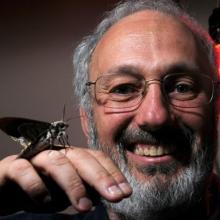
Goggy Davidowitz Professor assistente na Universidade do Arizona. Nosso laboratório estuda fisiologia ecológica e evolutiva, principalmente de insetos. O tema comum entre todos os nossos projetos é; como os organismos ajustam seu crescimento em resposta a mudanças ambientais de curto ou longo prazo e quais são as consequências para o seu rendimento reprodutivo. Nós trabalhamos em múltiplas escalas, integrando diversas abordagens e sempre enfatizando o nível do organismos como um todo. Algumas das abordagens que nós utilizamos incluem ecologia de isótopos estáveis, calorimetria, respirometria, microcirurgia, energética, ecologia térmica e genética quantitativa. Nós combinamos trabalhos no campo, em estufas e em laboratório. 

What do pollinators do with the nectar they drink?

Pollinators are often attracted to flowers for the nectar rewards. Nectar is more than just sugar and water, it can also contain amino acids, fatty acids and microbes. We tracked the fate of these nectar components using stable carbon isotopes. Our results provide new insights on how pollinators utilize nectar and provide an explanation for how nectarivores such as monarch butterflies, hummingbirds and bats can migrate thousands of miles without sustaining debilitating oxidative damage while fueled on nectar alone.

Goggy Davidowitz Assistant Professor, University of Arizona. Our lab studies ecological and evolutionary physiology, mostly in insects. The common theme running through all our projects is; how do organisms adjust their growth in response to short- or long-term environmental change and what are the consequences to their reproductive output. We work at multiple scales, integrate a number of approaches and always emphasize the level of the whole organism. Some of the approaches we use include stable isotope ecology, calorimetry, respirometry, micro-surgery, energetics, thermal ecology and quantitative genetics. We combine work in the field, greenhouse, and lab.


Judith Bronstein (University of Arizona): Mutualism: What Do We Know, and Where Do We Go From Here?


                  Data: 04 de Julho de 2018
                  Date: July 04th, 2018

                  Hora: 13h:00
                  Time: 1h:00h PM

                  Local (Room): Sala de defesa de tese,
                  Bloco O, Prédio da Pós graduação,
                  Instituto de Biologia,
                  Unicamp, Campinas, São Paulo, Brasil

Mutualismo: O que nós sabemos e para onde vamos a partir daqui?

Nesta palestra, eu revisarei a conturbada história dos estudos de mutualismo, um campo que apenas coalesceu nos últimos vinte anos. Eu identificarei cinco principais direções de pesquisa e, então, apresentarei nossos trabalhos recentes sobre a polinização por esfingídeos para mostrar como eles podem ser integrados para levar nossa compreensão adiante. Concluirei discutindo questões urgentes envolvendo mutualismo que provavelmente conduzirão o campo no futuro.

Judith Bronstein Professora honoraria (Universidade do Arizona, EUA). Utilizando uma combinação de observações de campo e experimentos, eu investigo como processos de populações, condições abióticas e o contexto das comunidades determinam os efeitos líquidos das interações para o aptidão de cada espécies participante. Áreas conceituais específicas de interesse incluem: (1) conflito de interesse mutualistas e as suas consequências para a manutenção dos resultados benéficos dessas interações e (2) resultados dependentes de contexto em mutualismos e antagonismos. Eu também tenho colaborado em investigações teóricas e empíricas sobre (i) a fragilidade dos mutualismos sobre a luz de ameaças à conservação e mecanismos para a restauração de interações rompidas e (ii) as causas e as consequências de "trapaças" dentro dos mutualismos.

Mutualism: What Do We Know, and Where Do We Go From Here?

In this talk, I review the checkered history of the study of mutualism, a field that has only coalesced in the past twenty years. I will identify five major research directions, then present our own recent work on hawkmoth pollination to show how they can be integrated to move our understanding forward. I conclude by discussing pressing issues surrounding mutualism that are likely to drive the field in the coming years.

Judith Bronstein University Distinguished Professor (University of Arizona, EUA). Using a combination of field observations and experiments, I investigate how population processes, abiotic conditions and community context determine net effects of the interactions for the fitness of each participant species. Specific conceptual areas of interest include: (1) conflicts of interest between mutualists and their consequences for the maintenance of beneficial outcomes in these interactions and (2) context-dependent outcomes in both mutualisms and antagonisms. I am also collaborating on theoretical and empirical investigation of (i) the fragility of mutualisms in light of conservation threats and mechanisms of restoring disrupted interactions and (ii) the causes and consequences of “cheating” within mutualism.